How To Remove Header And Footer In Word For Mac 2011
I want to turn on the Different First Page option right here. Two things happen.
To do that, go to the page 3 and double-click inside the header area to enter the header / footer editor. Click on the purple Header and Footer tab. There un-check the Link to Previous check-box to disable the linking 4. Do the same for the footer. Scroll down to the footer area on the page 3, click somewhere inside it and un-check the Link to Previous check-box 5. You can now safely delete or modify the header and footer from the first two pages. You can use the Zoom menu to make it easier to edit header and footer content. By default, page numbers are included in the center of the footer section. If you want to remove the page numbers, you can select one in the preview and delete it. This document contains instructions for doing a 'Different first page' for Microsoft Word for Mac and Windows. For Mac Word 2011: Go to File on the menu bar --> Page Setup; Change the settings to Microsoft Word; Click on the Margins button; Click on the Layout Button, then select 'Different first page' and click OK; Now you have a different first page header.
The terms Header and Footer arrived from the word processing programs. These denote repeated elements that show at the top and bottom of every page. Headers and Footers are different from each other on PowerPoint slides only considering their position, the Footer is a line of text that usually appears at the bottom of a slide, as shown highlighted in red within Figure 1 below. Figure 1: Footer in PowerPoint Typically, the Footer area includes three placeholders: • Date • Footer (You add a message, a company name, or anything you want to be visible on all slides here) • Slide number By default, the footer with one or more of these three placeholders appears on every slide in a presentation, but you can change that as required. You can also move the content within the Footer area to the top of your slide, as shown highlighted in red within Figure 2.
Then choose whether you want the date and time to Update Automatically, or set them to Fixed: • i. Update Automatically: Select this radio button and then open the drop-down list (see Figure 5) to choose a date (or date and time) format. • Figure 5: Date (or date and time) format drop-down list • ii. Fixed: Select this radio button and enter a date in the text box, as shown in Figure 6 below (highlighted in red). By default, this uses the current date, also the date remains the same no matter when or where you edit or deliver your presentation.
Customizing Word • • • • Conclusion Conclusion •.
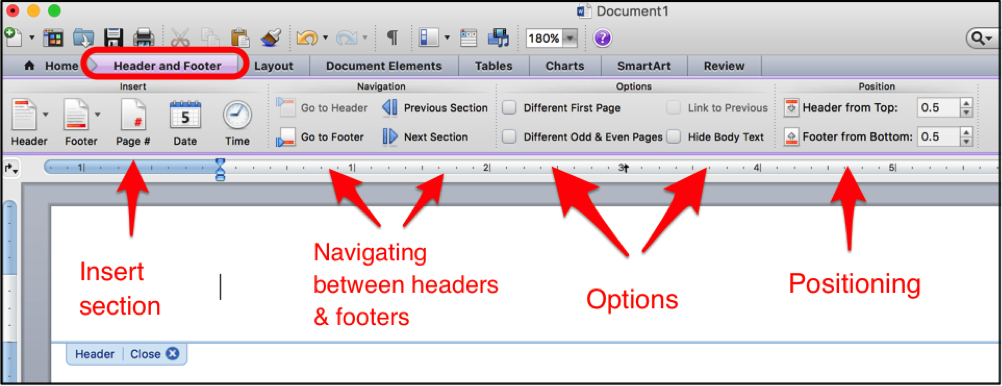
Click the Page # button on the Ribbon to display the Page Numbers dialog, which you can use to choose alignment and formatting options for your page numbers. To exit Header and Footer view, choose a view from the views listed in the topmost group of the View menu, or double-click the document body. You can also click the small Close button below the Header or above the Footer area. You may want to format your Header or Footer to display Page # of #. To make this custom format starting without a Header or Footer style, do the following: • Choose View→Header and Footer from the menu bar. • Click within either the Header or Footer area. Your cursor will be at the left.
The quick way to work with headers and footers is by way of the Header and Footer group on the Office 2011 Ribbon’s Document Elements tab. Clicking either the Header or Footer button displays a gallery from which you can choose a style for your header or footer. The basic layout of three positions (left, center, and right) is the first style on the palette.
Maria Langer is a technology educator and the author of more than 80 computer how-to books. Maria Langer has been working with and writing about Macintosh and Windows computers and software since 1990. She specializes in Mac OS, productivity applications, blogging, social networking, and ebook publishing.
Controlling Privacy and Security 20. Controlling Privacy and Security • • • 21. Printing Documents 21. Printing Documents • • • • • 22. Using Macros 22.
It took me quite a while to find the corresponding options in Word 2011 to make the first page header/footer behave differently than the others. But I found it at the end by sheer luck after having it circumvented through another option. And no, there’s no ribbon bar option like in Word 2010 😉 In the Menubar go to: Format -> Document There select the Layout tab.
• Immediately after typing the final line of your paper, click on Insert => Break => Page Break (to begin a new page). Your header with your last name and automatic page numbering should appear at the top left of your paper.
How To Remove Header And Footer From Word Document
When we enter zero in the Header and Footer fields, we are defining the offset of the item to the top/bottom of the printable area. We don't set the item's height to zero.
Type your text into the formatted header. You can also bypass the format and click in the header (or footer) area and begin typing to manually format the header or footer. • The information appears in the header or footer of every page of the document.
• Click on 2.0 and done. How to Enter the First Page Information: • Type your full name => press Enter. • Type your professor’s name => press Enter. • Type course title => press Enter.
Note: When you customize your header or footer, you can add images, page numbers, date, time, sheet name, file name and path, and more. Add an image to a header or footer • On the Layout tab, under View, click Page Layout. • On the Layout tab, under Page Setup, click Header & Footer.
What's Hot at TechRepublic • • • • Headers and footers are easy to implement as long as the same text appears on every page in your document. Beyond the basics, this feature often confuses users. The key to working successfully with headers and footers is this: headers and footers belong to sections, not the document or individual pages, and a document can have a unique header or footer for every section. Changing a document's header of footer is as simple as adding a new section, almost. In truth, changing a document's header is a three-step process: • Insert a page break. • Break the link between the previous section and the new section. • Change the header/footer.
It • Practice while you learn with exercise files. Watch this course anytime, anywhere. Course Contents • Introduction Introduction • • • • 1. Understanding the Word Interface 1.
See screenshot: Delete any kind of header or footer. Increase your productivity in 5 minutes. Don't need any special skills, save two hours every day! 300 New Features for Excel, Make Excel Much Easy and Powerful: • Merge Cell/Rows/Columns without Losing Data. • Combine and Consolidate Multiple Sheets and Workbooks.
See screenshot: 2. Then repeat step 1 to delete the headers in section 2.
Then repeat step 1 to delete the headers in section 2. Put the cursor on the section 1 and click Insert > Footer > Remove Footer to remove the footers in section 1. See screenshot: 4. Then repeat step 3 to delete the footers in section 2. Click File > Check for Issues > Inspect Document, see screenshot: 2.
On the Design tab, check the 'Different First Page' checkbox under Options group. You can now put a different header on the first page or make it blank. Create a new header or footer in your second page; this will print on all subsequent pages.
If you would like to include headers and footers when you print your Numbers spreadsheets in Numbers 3.2 and later, you can do this by editing them on the Print Setup screen. • Choose Print from the File menu. • You should see a preview of how the sheet will look when you print it. • To edit the headers for the sheet, click the top of any page and add the information you would like there. To edit the footers, click the bottom of any page and add the information there. I can delete characters in the header, but I can't add any new characters -- the keyboard doesn't respond.
See screenshot: 3. Repeat the step 2 to disable the Link to Previous option. Then select one header and press Backspace to delete it, and all the headers are remove at the same time. See screenshot: 4. Repeat the above steps to remove all footers. Put the cursor on the section 1, and click Insert > Header > Remove Header to remove the headers in section 1.
At this point, selecting the 'no borders' option once more – finally deleted the line. Repeating this once on another page saw it disappear on every one of my 365 page footers. Pdf editor for mac. Feel free to post this on your site as an update - it may save many others time and PAIN.
See screenshot: Note: If you are using Excel 2010 or older versions, this dialog box won't come out. Please just skip this step. In the Insert Picture dialog box, please search and select the specified logo or image you will insert as header or footer, and click the Insert button. See screenshot: 4. And now the text string of &[Picture] is inserted into the header or footer. Click any cell in the active worksheet, and you will see the logo or image has been inserted as header or footer. See screenshot: Note: After inserting a picture header/footer, you can format it with selecting the picture header or footer, clicking Design > Format Picture, and then formatting in the Format Picture dialog box.
By doing so, you change a Footer to a Header! Figure 2: Footer moved to the top of the slide In this tutorial, we'll learn how to make Footers (or Headers) visible on your slides: • Open the presentation where you want to add a Header or Footer. Choose the Insert Header and Footer menu option as shown in Figure 3. • Figure 3: Header and Footer option within Insert menu • This brings up the Header and Footer dialog box, as shown in Figure 4. • Figure 4: Slide tab within Header and Footer dialog box • Make sure that the Slide tab is selected within the Header and Footer dialog box, so that the options you select or deselect will only affect the slides you see on screen rather than your printed handouts. All these options are explained below, as marked in Figure 4: A. Date and time• Select this check-box to make the date appear on your slide(s).
You can see all the headers and footers are removed. Click Insert > Header > Remove Header to remove all headers. Click Insert > Footer > Remove Footer to remove all footers. Remove all multiple headers and footers If your document has divided into several sections, and every section has each header, you can remove them by following methods: Method 1 1. Double click the top of the document to edit the header and footer, see screenshot: 2. Put the cursor on the Header 2 in section 2 and click Design and check Link to Previous.
• Now type your sources. If you have Internet sources, when you type in the URL, Microsoft Word automatically apply the hyperlink to it. You should remove the hyperlink by right-clicking on the URL => Hyperlink => Edit Hyperlink => Remove Hyperlink. I hope you found this tutorial helpful.
At this point, you're ready to change the header. Simply change the text, field, or object as you normally would. Worth noting When working with section breaks, use the Show/Hide option (on the Home tab in the Paragraph group) to display them.
• Click on the Tab key to indent 1/2 inch to begin your first paragraph. Use the Tab key on every next new paragraphs. Your completed setting should look like this: How to Setup the Works Cited Page: Follow this how-to when you are ready to work on your Works Cited page.
• Click the Header and Footer tab, and then under Navigation, select one of the options.
Note: If there are watermarks in the document will be removed, too. Kutools for Word More than 100 Advanced Functions for Word 2003, 2007, 2010, 2013, 2016 and 2019 .
Now your document has 3 sections and when we insert page numbering it will only number that section. Step 2: Insert the Page Numbers Navigate to the first page you want numbered (page 3 in my example). Click Insert => Page Numbers Ensure ‘show number on first page’ is checked Click Format Under ‘page numbering’, select Start At and enter “1” That’s it! You can now update your contents page and it will refer to your shiny new page number format. This took me a long time to work out. I’m writing this primarily for my awesome wife who writes way more essays than I do.:-) More Help Although I don't think it covers this exact scenario, these are cheap (~$3) and have really helped me learn where all the useful features are without having to google everything.
SEE: (Tech Pro Research) Step One When you need a different header of footer, the first step is to enter a section break as follows: • Click the Page Layout tab. In the Page Setup group, choose the appropriate break option from the Breaks dropdown. • In Word 2003, choose Break from the Insert menu. Choose a break from the resulting dialog and click OK. Where to put the section break might cause some confusion. Generally, you'll insert a Next Page section break at the bottom of the page that falls just before the page where you want the new header or footer to begin.
If you want something more in-depth, seems to be the best office for mac book around, and covers formatting in a lot more detail than the books.
• Word determines the spacing based on the default unit of measurement, for example, inches. To change the unit of measurement, on the Word menu, click Preferences, click General, and then on the Measurement units pop-up menu, choose a unit of measure. Move between headers and footers in your document You can scroll between the header and footer in your document, or you can use the tools on the Header and Footer tab to move between headers and footers in different sections of your document. • On the View menu, click Print Layout. • In the document, double-click the header or footer.
This document contains instructions for doing a 'Different first page' for Microsoft Word for Mac and Windows. For Mac Word 2011: • Go to File on the menu bar --> Page Setup • Change the settings to Microsoft Word • Click on the Margins button • Click on the Layout Button, then select 'Different first page' and click OK • Now you have a different first page header: To view this go to VIew on the menu bar and select Header and footer. For Windows Word 2007/Word 2010 • Go to Insert on the Ribbon, click on the Header icon and then select Edit Header • Locate the ' Design ' located under the title 'Header & Footer Tools' Check the box 'Different First Page' • You will then see the new 'Header' area.
A workaround allowing us to get quite zero margins in Pages: Put the cursor in a header. Define the font size to 1. Put the cursor in a footer. Define the font size to 1. Doesn't apply to Numbers.
• Type your paper’s due date => press Enter. • Click on the Align Center icon on the formatting toolbar (to center your blinking cursor) => Type the title of your paper, capitalizing the first letter and all major words and proper nouns. Do not use italics, boldfaced type, underlining, or all caps to format your title. Do not type a period at the end of the title => press Enter. • Click on the Align Left icon (to bring your blinking cursor to the left).
Press Tab once or twice to move to the center or right, if desired. • Type the word “Page,” followed by a space. • Choose Insert→Field from the menu bar.
Learning the Basics of Text Editing • • • • • • 5. Formatting Text Characters 5. Formatting Text Characters • • • • • 6. Formatting Paragraphs 6. Formatting Paragraphs • • • • • • 7. Working with Tab Tables 7. Working with Tab Tables • • • • 8.
Comments are closed.